
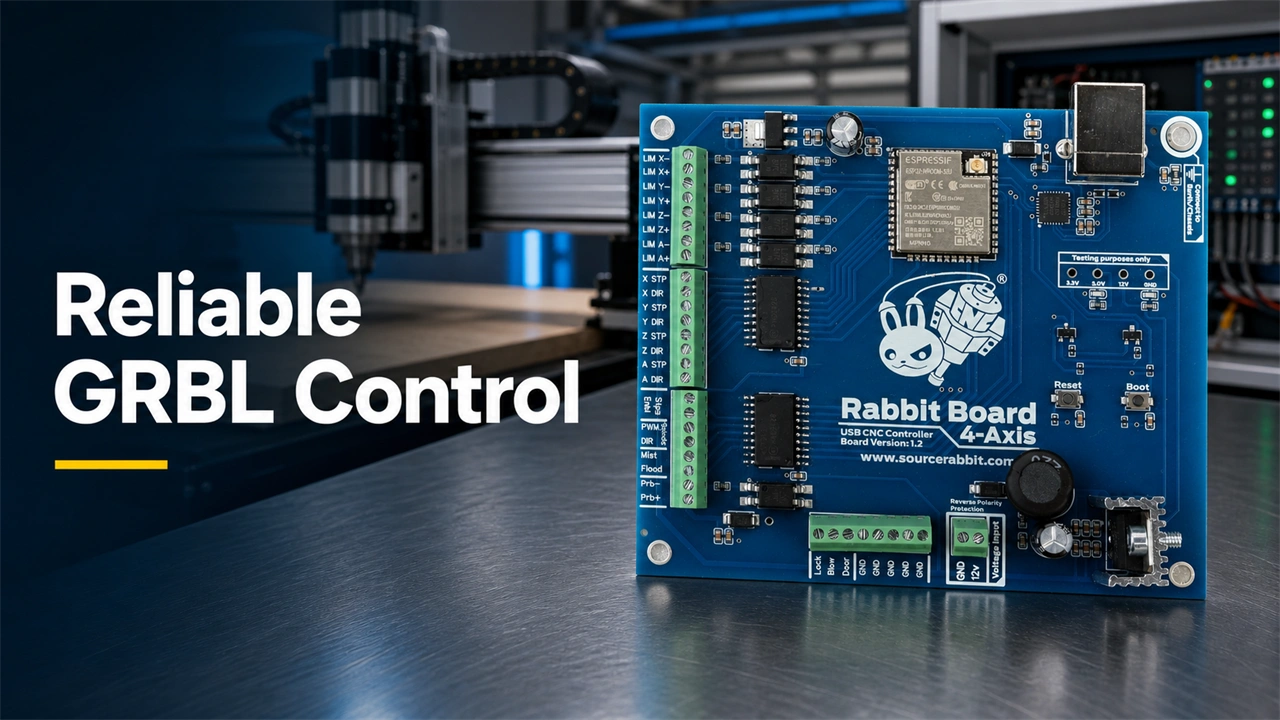
Building a reliable CNC machine requires more than selecting a fast microcontroller and adding a few connectors. The controller must generate accurate motion signals, communicate reliably with the control computer, and continue operating predictably near motor drivers, power supplies, relays, and spindle electronics.
The Rabbit Board 4-Axis was designed for these real operating conditions. It is a fully assembled CNC motion controller for up to four stepper or servo axes, featuring buffered outputs, protected 12V machine inputs, and both USB and WiFi connectivity.
Motion Control for Up to Four Axes
At the center of the board is an ESP32-WROOM-32, featuring a dual-core 32-bit Xtensa processor running at 240 MHz and integrated WiFi connectivity.
The board is supplied with Rabbit GRBL pre-installed and can control up to four external stepper or servo drivers using standard STEP/DIR signals, with a maximum step frequency of 120 kHz.
This makes it suitable for CNC routers, mills, rotary-axis systems, and custom motion-control applications.
The Rabbit Board does not drive motors directly. It generates the timing and control signals required by external motor drivers, allowing the machine builder to select the appropriate drivers and motors according to the voltage, current, torque, and performance requirements of the machine.
Buffered 5V Control Outputs
Microcontroller pins should not be treated as field wiring. External drivers, long cables, relays, and other machine electronics can place unwanted electrical loads directly on the processor.
For this reason, the Rabbit Board uses two 74ACT245 octal bus transceivers to buffer its machine-control signals.
The buffered outputs include:
- STEP and DIR for four axes
- Spindle PWM up to 10 kHz
- Spindle Enable
- Mist coolant control
- Flood coolant control
The buffers accept the ESP32’s 3.3V logic signals and provide clean 5V outputs. This improves compatibility with external motor drivers while keeping their electrical loading away from the processor pins.
12V Machine Inputs
Limit switches and probes are commonly installed several meters away from the controller. Their cables may pass close to motor wiring, spindle cables, switching power supplies, contactors, and relays.
The Rabbit Board provides:
- Four 12V limit-switch inputs
- One 12V tool setter or probe input
- An
LTV-817optocoupler on each input
Each external signal passes through an optocoupler before reaching the ESP32. The processor therefore receives a clean 3.3V logic signal rather than being connected directly to the external 12V circuit.
Using 12V field signals provides a greater noise margin than connecting long machine cables directly to 3.3V microcontroller inputs.
The optocouplers provide signal conditioning and protection. Because the circuit uses a common ground reference, however, the inputs should not be described as providing complete galvanic isolation between independently grounded systems.
Normally Closed Limit Switches
Normally Closed contacts are recommended for CNC limit switches.
With NC wiring, the circuit remains closed during normal operation. Activating the switch opens the circuit and is detected by the controller.
The same change can also reveal several wiring faults:
- A broken cable
- A disconnected limit switch
- A loose connector
- Loss of input power
With Normally Open wiring, some of these problems may remain undetected until the limit switch is actually required.
Protected and Filtered Power
The Rabbit Board operates from a 12V DC power supply.
A series Schottky diode provides reverse-polarity protection. An input inductor and multiple capacitors filter the supply before power reaches the rest of the circuit.
The internal voltage rails are generated by:
- An
LM7805linear regulator for 5V - An
AMS1117-3.3linear regulator for 3.3V
Local filtering and decoupling are also provided around the power stages and digital integrated circuits.
This straightforward linear power architecture provides stable logic supplies without adding switching-regulator noise directly to the board.
USB and WiFi Connectivity
The Rabbit Board 4-Axis is not restricted to a single communication method. Both the hardware and the pre-installed Rabbit GRBL firmware support USB and WiFi communication.
This gives the machine builder the flexibility to select a wired or wireless connection according to the CNC installation and workshop layout.
USB Connection
For direct wired communication, the board provides USB 2.0 through a CP2102 USB-to-UART interface and a full-size USB Type-B connector.
The USB circuit includes:
- ESD protection
- A common-mode choke on the data lines
- Filtered VBUS power
- Controlled coupling between the USB shield and circuit ground
The common-mode choke helps limit noise travelling through the USB data lines, while the ESD protection handles electrostatic discharges and transient voltages.
USB is a practical option when the control computer is located close to the CNC machine and a dedicated physical connection is preferred.
WiFi Connection
The ESP32 provides the wireless networking hardware, while Rabbit GRBL provides WiFi communication support.
Compatible CNC software can therefore communicate with the controller through the local network without relying exclusively on a USB cable.
WiFi connectivity is useful when:
- The computer cannot be placed close to the machine
- Routing a USB cable is inconvenient
- The workshop layout benefits from network communication
- A wireless CNC control workflow is preferred
USB and WiFi are not separate add-ons. They are two communication options provided by the same Rabbit Board and Rabbit GRBL control platform.
Integration with CNC Software
The Rabbit Board can be used with compatible GRBL-based CNC control and G-code sender applications.
For an integrated SourceRabbit workflow, it can be paired with Focus – CNC Control System through either USB or WiFi.
Focus handles the user interface, machine operation, and job workflow. The Rabbit Board executes the G-code, performs motion planning, controls the machine I/O, and generates the time-critical STEP/DIR signals.
This separation allows the computer to manage the user experience while the controller handles real-time machine operation independently.
Designed for Real CNC Installations
Many controller boards can move motors during a bench test. A CNC controller must continue working after it is installed next to the electrical systems of a real machine.
The Rabbit Board 4-Axis was developed around practical engineering choices:
- Four-axis STEP/DIR motion control
- Buffered 5V control outputs
- 12V optocoupler-conditioned inputs
- NC limit-switch fault detection
- Protected and filtered 12V power input
- Filtered USB interface with ESD protection
- USB and WiFi connectivity
- Rabbit GRBL with USB and WiFi support
- Compatibility with external stepper and servo drivers
Correct grounding, shielding, cable routing, and control-box design remain essential. No controller can compensate for a fundamentally incorrect electrical installation.
The Rabbit Board does, however, provide a carefully designed foundation for building a stable and predictable CNC control system.
A Flexible CNC Control Platform
The Rabbit Board 4-Axis combines GRBL motion control, robust machine I/O, and the flexibility of USB and WiFi communication.
It connects CNC software to the motor drivers, spindle controls, coolant systems, limit switches, and probe while generating the precise signals required to operate the machine.
The result is a practical four-axis controller designed not only to move motors, but to become the central motion-control component of a real CNC installation.
Learn more on the Rabbit Board 4-Axis product page.