
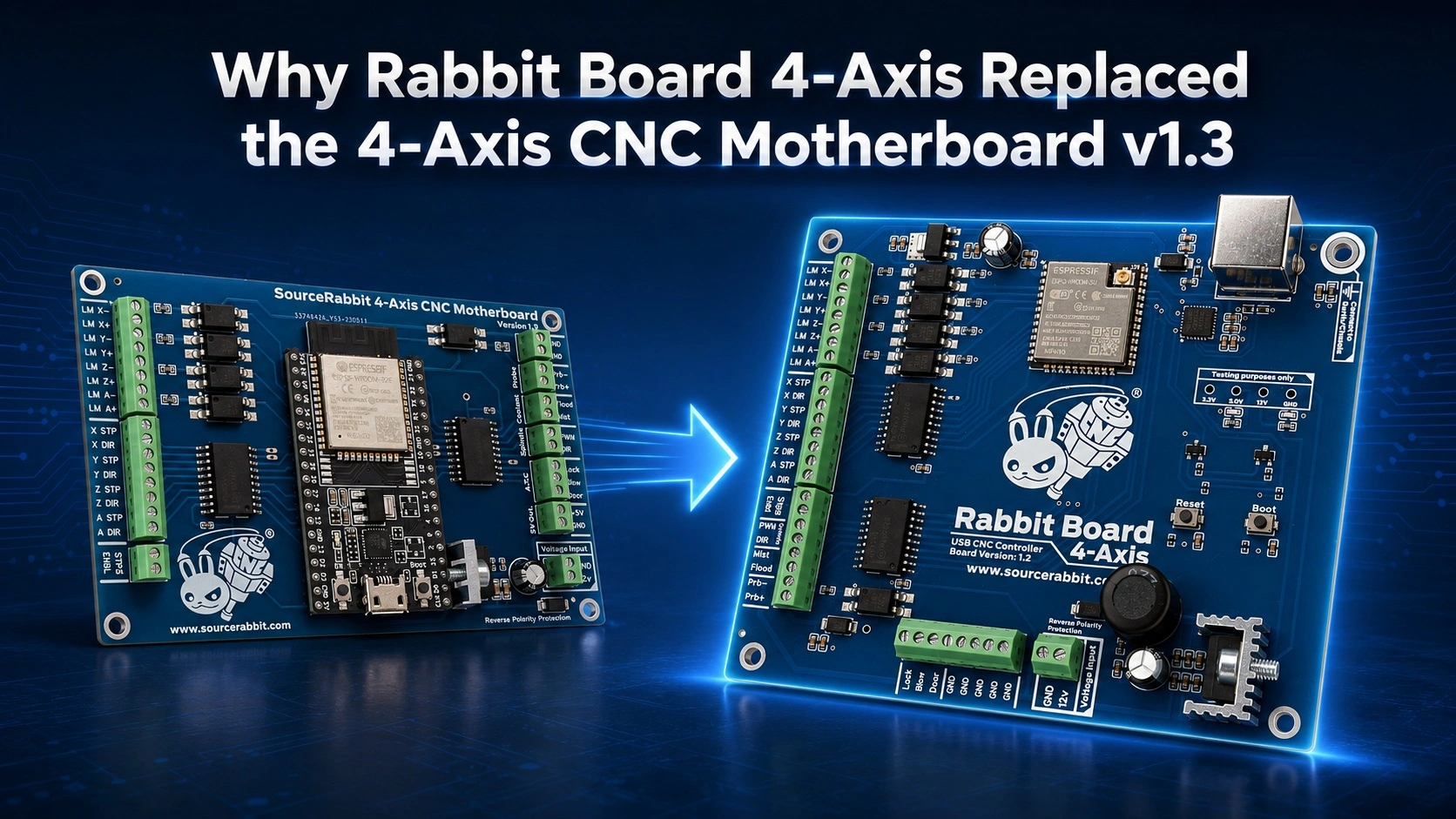
The 4-Axis CNC Motherboard v1.3 was designed as a compact and practical GRBL-based motion controller for CNC machines that use external stepper or servo drivers. It offered 4-axis STEP/DIR control, opto-isolated limit and probe inputs, spindle and coolant outputs, and compatibility with GRBL-based G-code sender applications.
Over time, however, real CNC installations showed us where the board could be improved. CNC controllers are often installed inside control boxes together with motor drivers, switching power supplies, spindle equipment, relays, and long machine wiring. These are demanding environments, and small hardware details can make a big difference in reliability.
This is why we replaced the 4-Axis CNC Motherboard v1.3 with the new Rabbit Board 4-Axis.
Designed for Better WiFi Installations
The previous board used an ESP32 module with an onboard WiFi antenna, which worked well in many simple setups. In real CNC machines, however, the controller is often installed inside a metal or partially enclosed control box, close to other electronics and wiring. These conditions can reduce WiFi performance.
Rabbit Board 4-Axis uses an ESP32-WROOM-32U module with support for an external WiFi antenna. This allows the antenna to be placed in a better position, such as outside the control enclosure or closer to an open area of the machine.
USB remains the most dependable wired connection, but for users who prefer WiFi control, external antenna support gives the installer more control over signal quality and makes the board more suitable for real workshop installations.
Cleaner and More Robust Power Design
CNC environments are electrically noisy. A motion controller must keep working reliably while motor drivers, spindle controllers, switching power supplies, and relays operate nearby. For that reason, clean and stable power is not just a small detail; it directly affects communication stability, input reliability, and overall controller behavior.
Rabbit Board 4-Axis improves the power design around the 12V input, the 5V rail, and the 3.3V logic supply used by the ESP32 and board electronics. Compared to the previous board, the new design focuses more on filtering, stable regulation, and a cleaner power path for the controller logic.
For this reason, we intentionally use selected THT components in key parts of the power section, such as inductors and electrolytic capacitors. This is not the cheapest way to build a compact controller board, but it helps us create a more robust power stage with better filtering capacity and better tolerance for real CNC control box conditions.
Our goal with Rabbit Board 4-Axis was not to build the cheapest board possible. We wanted to offer something more dependable than the low-cost controller boards commonly found on the market, especially for users who build real CNC machines and expect their electronics to work reliably under demanding conditions.
Same CNC Workflow, Better Hardware Foundation
We kept the practical features that made the original board useful: 4-axis STEP/DIR outputs, opto-isolated limit and probe inputs, spindle PWM and direction control, coolant outputs, ATC-related outputs, and compatibility with GRBL-based G-code sender applications.
Rabbit Board 4-Axis is not a completely different idea. It is the natural replacement for the 4-Axis CNC Motherboard v1.3. It keeps the same CNC workflow, but improves the hardware areas that matter most in real machines: WiFi flexibility through external antenna support and a cleaner, more robust power design.
The 4-Axis CNC Motherboard v1.3 is no longer available, and Rabbit Board 4-Axis is now the recommended SourceRabbit 4-axis CNC motion controller.