Connecting Stepper or Servo Drivers
Connect external stepper or servo drivers to the STEP, DIR, and ENABLE control outputs of the Rabbit Board 4-Axis.
External Motor Drivers Are Required
The Rabbit Board 4-Axis is a motion controller that generates control signals for up to four axes: X, Y, Z, and A. It does not supply motor power and must not be connected directly to stepper motor windings or servo motors.
Each motor requires a suitable external stepper or servo driver that accepts STEP/DIR control signals. Some drivers label these inputs as PUL/DIR, CP/CW, or Pulse/Direction. Confirm compatibility in the motor driver manual before making any connection.
Disconnect Power Before Wiring
Turn off and fully disconnect power from the Rabbit Board, motor drivers, motor power supplies, and the complete CNC control box before connecting or disconnecting any wire. Verify that no residual voltage remains.
Never connect or disconnect a motor from its driver while the driver is powered. Doing so can damage the driver. Check the driver input specifications, motor current, supply voltage, microstep settings, and wiring diagram before continuing.
Connect the STEP and DIR Signals
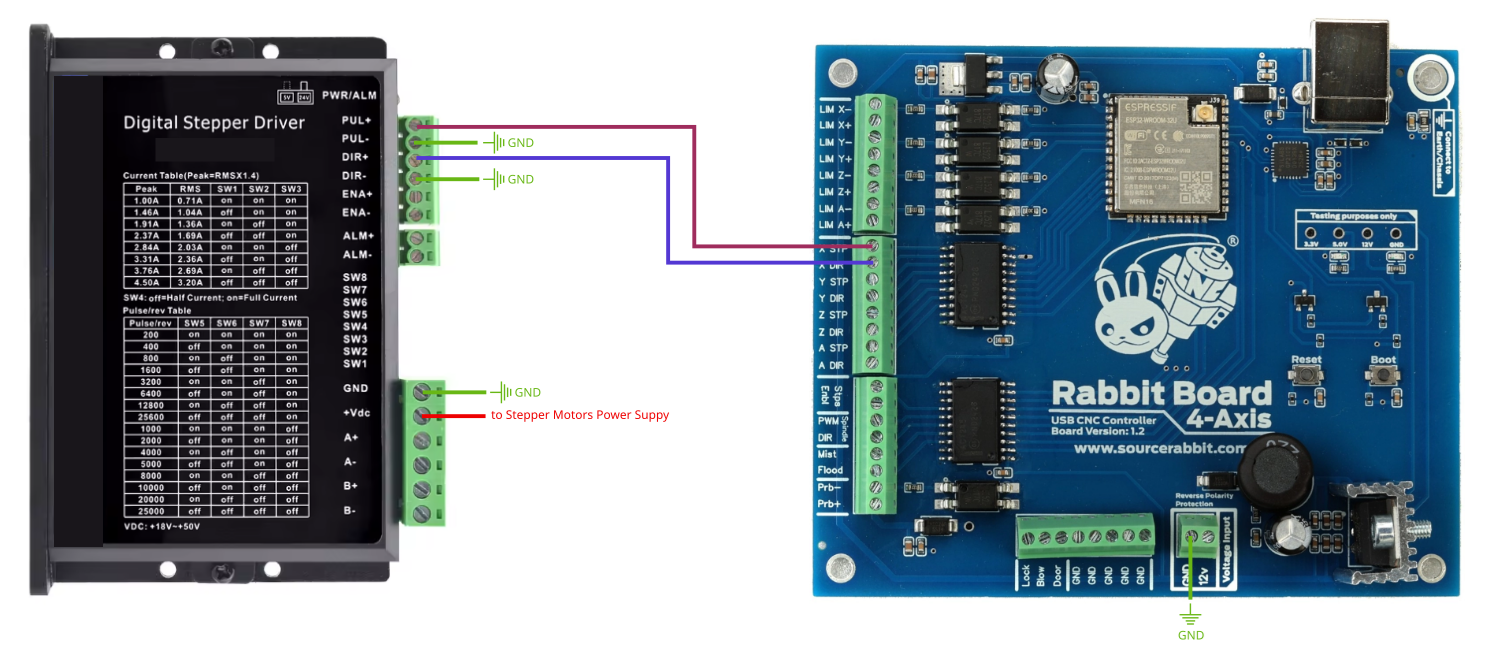
Connect the STEP output of the required Rabbit Board axis to the pulse or step input of the external driver. Connect the corresponding DIR output to the driver direction input. Repeat the same wiring method for the remaining X, Y, Z, and A axes.
Driver input terminals may use labels such as PUL+/PUL-, STEP+/STEP-, DIR+/DIR-, or CW+/CW-. Follow the driver manufacturer's diagram for its required common-anode, common-cathode, or differential input arrangement. Do not assume that terminal polarity and input voltage are the same on every driver.
Connect the ENABLE Signal When Required
The Rabbit Board provides enable control signals for external motor drivers. Connect ENABLE only when the driver supports a compatible enable input and when remote enable control is required by the installation.
Depending on the driver, the enable input may be labeled EN, ENA, ENABLE, or FREE. Some drivers can operate correctly with this input left unconnected. Follow the driver manual and do not bridge or apply voltage to an enable terminal unless its electrical requirements are known.
Provide a Common Ground Reference
DC-powered motor drivers and the Rabbit Board must have a compatible common signal reference. Use a central star-ground arrangement so the Rabbit Board ground, driver signal grounds, and DC power-supply grounds converge at a common reference point. This helps prevent ground loops and reduces electrical noise.
If a servo driver or motor driver is powered directly from AC, refer to its manual for the correct isolated input wiring method. Protective earth and DC signal ground have different purposes. Do not connect them together arbitrarily.
Use Noise-Resistant Signal Wiring
Use twisted-pair wiring for STEP and DIR signals and their corresponding returns. For electrically noisy installations, use suitable shielded signal cable and terminate the shield according to the system design and equipment manufacturer's instructions.
Keep STEP/DIR wiring away from mains cables, motor power cables, spindle wiring, relays, and VFD output cables. Avoid long parallel cable runs. If signal and power cables must cross, crossing them at approximately 90 degrees helps reduce electromagnetic coupling.
Perform a Safe First Movement Test
Before the first test, inspect every connection, verify the motor driver current and microstep settings, and make sure the axis can move without hitting a limit, fixture, or machine component. Keep the emergency stop accessible and remove cutting tools or other hazards where practical.
Power the system and command a short, low-speed jog on one axis at a time. Confirm that only the intended axis moves and that its direction is correct. If the direction is reversed, stop the machine and correct the direction using the Rabbit GRBL direction setting or the driver and motor wiring method specified by the manufacturer. Never change motor wiring while the driver is powered.